IELTS Trainer 2 Listening Test 4
40 questions across 4 parts. Cambridge IELTS Trainer 2 (Academic).
Part 1 audio:
Speed:
Part 1Questions 1–10
Island Transport
Complete the notes below.
Write NO MORE THAN TWO WORDS AND/OR A NUMBER for each answer.
Island Transport
| Vehicles | Cost | Comments |
|---|---|---|
| Motor scooter (example) | $1 per day |
|
| Economy car | $87.80 per day |
|
| E-Bike | $6 per day |
|
Part 2Questions 11–20
The Community Garden
Questions 11–15 · Choose the correct letter, A, B or C.
11 What was recently discovered at this site?
12 This location is good for gardening because
13 In 1860, what was built on this site?
14 Today, the fruit and vegetables from the gardens
15 The local college now uses the gardens
Questions 16–20 · Label the map below. Write the correct letter, A–H, next to each place.
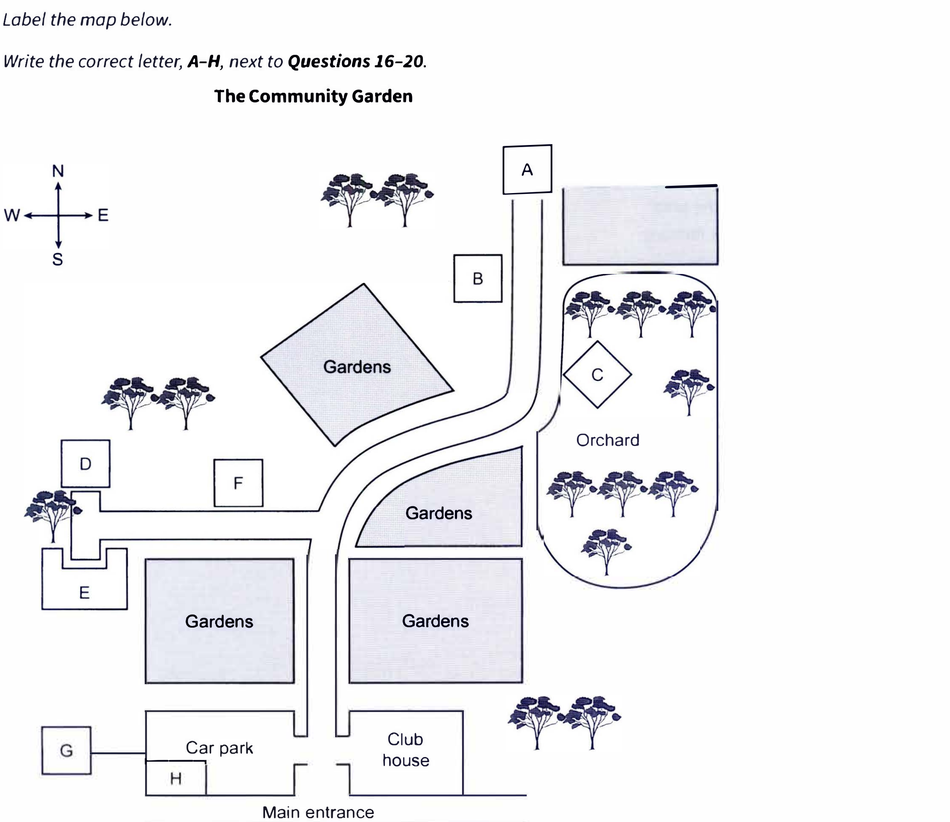
16worm farms
17seed store
18machinery shed
19compost heaps
20drying room
Part 3Questions 21–30
The Benefits of Playing Video Games
Questions 21–25 · Choose the correct letter, A, B or C.
21 According to Alya and Jason, Dr Franklin showed that video games have
22 According to the students, what is the biggest advantage of games in therapy?
23 When discussing the Singapore study, the students disagree about
24 What impresses the students about the anxiety research?
25 The students agree that the Rhode Island research
Questions 26–30 · What opinion do the students express about each research study?
Choose FIVE answers from the box (A–G) and write the correct letter next to each study.
A — the finding may disappoint some businesses
B — the finding contradicts other research
C — the finding is relevant in particular countries
D — the finding is not believable
E — the finding is supported by various studies
F — the finding is not a surprise
G — the finding will become increasingly important
26surgeon study
27vision study
28sport study
29ageing study
30career study
Part 4Questions 31–40
Traditional Polynesian Navigation
Complete the notes below.
Write ONE WORD ONLY for each answer.
Traditional Polynesian Navigation
Introduction
- the islands of Polynesia are in the Pacific Ocean
- the Polynesian peoples originally migrated from 31 to the Pacific islands
- European explorers were impressed that Polynesian canoes were 32 than European ships
Equipment on ocean-going canoes
- paddles were used for 33
- sails were made from the pandanus plant
- warm clothes were made from the 34 of the paper mulberry tree
How Polynesians navigated at sea
- they did not have the magnetic compass
- they remembered where stars rose and set by making up detailed 35
- when it was cloudy, they found the direction by using 36
Finding new islands
- they could identify certain 37 that only live near land
- close to land, they could read changes in the sea's 38
Recent history
- in 1976 the canoe Hokule'a sailed from Hawaii to Tahiti without 39
- now replica traditional canoes have sailed across the Pacific and around the world
- as well as sailing, these voyages have created fresh interest in Polynesian culture, music and 40