IELTS Listening Practice Test 13
40 questions across 4 sections. From 80 Academic Listening Tests (Second Edition).
The Volunteer Agency
Questions 1–6
Complete the notes below.
Write NO MORE THAN TWO WORDS AND/OR A NUMBER for each answer.
The Volunteer Agency
- has recruited 1 people for environmental projects
- project abroad involves doing 2 or going into the rain forest
- major project for dealing with 3 in the countryside
- project for improving conditions for 4
- 5 projects in urban areas
- some projects do not have any 6
Questions 7–10
Complete the table below.
Write ONE WORD for each answer.
| Name of organisation | Numbers | Example volunteer activity |
|---|---|---|
| Wildlife Link | 24,000 volunteers | getting information about 7 of wildlife |
| Wildlife Watch | 300 8 | doing administrative work |
| 9 Earth | 908 projects | building 10 and walls |
Visitor Centre — Vending Machines
Questions 11–14
Where will the following machines be?
Choose FOUR answers from the box and write the correct letter, A–F, next to questions 11–14.
Questions 15–20
Label the diagram below.
Write ONE OR TWO WORDS AND/OR A NUMBER for each answer.
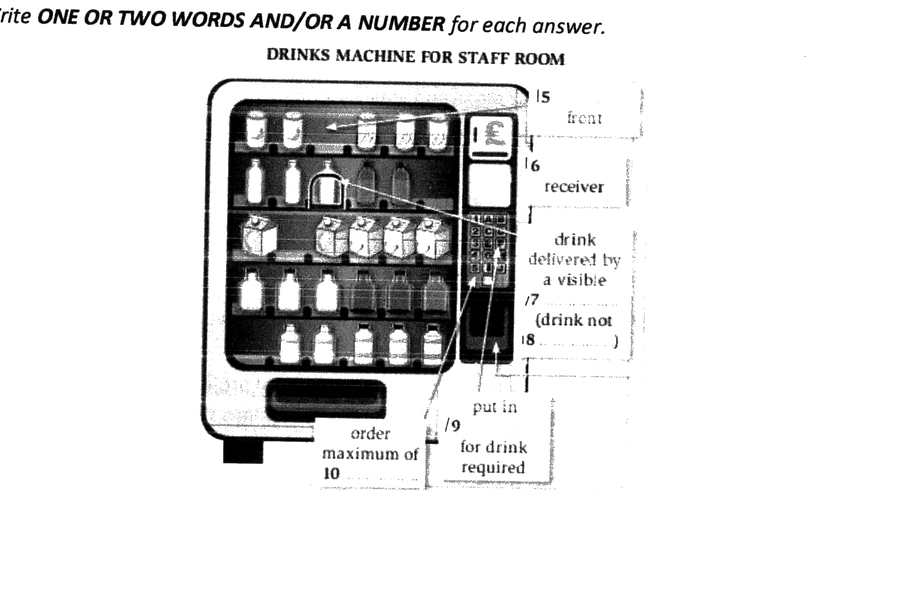 DRINKS MACHINE FOR STAFF ROOM — diagram with labelled parts 15–20
Maya's Lifelong Friendships Presentation
Questions 21–25
Choose the correct letter, A, B or C.
Questions 26–30
Complete the flow chart below.
Write NO MORE THAN TWO WORDS for each answer.
The History of Jeans (Levi Strauss)
Questions 31–40
Complete the sentences below.
Write NO MORE THAN TWO WORDS for each answer.
31 The word jeans may have originated in a material used in clothes worn by from Italy.
32 One difference between jean and denim material concerned the used to create them.
33 Denim was used in the clothes worn by people whose place of work was .
34 Strauss's first name was originally .
35 The miners' problem concerned the on their clothes.
36 Strauss's clothes solved the problem because they used fasteners.
37 The label Strauss added showed his waist overalls connected to .
38 In the 1930s, the clothes became more popular because people saw characters in wearing them.
39 In the 1940s, people in other countries saw the clothes being worn by from the U.S.
40 In the 1950s, teenagers called the clothes .